01
Design Brief
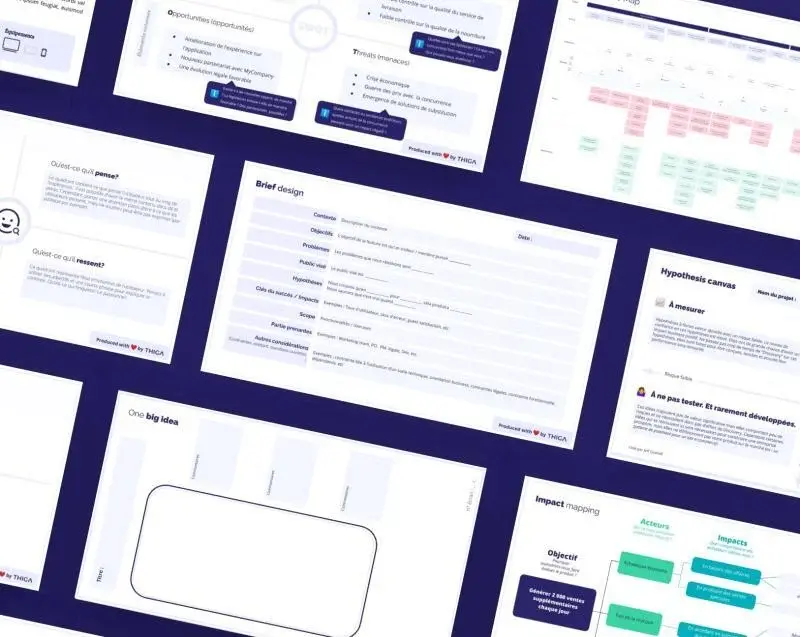
A problem-oriented framing document that gives meaning to the team in charge of providing solutions when introducing a design. Its purpose? To clarify the reasons for working on the subject, and to define the context and the problem.
02
Evaluation grid
The evaluation of the usability or UX of an interface in detail according to a set of predefined heuristics or pcriteria.
The aim is to eliminate obvious usability problems before user testing.
03
Hypothesis Canva
A complementary canva to the Lean UX Canva. It allows you to have an objective conversation with your teams and stakeholders about which assumptions you should or shouldn't focus on during the Discovery phases.
04
Empathy Map
An empathy map is a collaborative tool that lets you visualize what you know about a category of users of your product. The aim: to share a common vision of user needs, which also makes it an excellent decision-making tool.
05
Experience Map
It visualizes the overall experience of a lambda user who wants to accomplish a goal. In particular, it allows us to identify the key points of the experience and target the elements that need to be improved.
06
Crazy 8
A co-design workshop that invites participants to draw up 8 distinct ideas in 8 minutes. The aim: to go beyond the first idea, often the least innovative. It is often used in the Divergence phase of a Design Sprint.
07
6to1
6to1 is an ideation method to help us generate ideas. The aim of this workshop is to generate, develop, refine and select ideas.
08
One big idea
It's a workshop that encourages participants to focus on a design idea and push their thinking to the limit. Often following the Crazy8, it is the ultimate design exercise before the vote.
09
Impact Mapping
Impact mapping is a visualization tool whose design encourages contributors to focus on identifying initiatives that will help achieve a goal.
010
SWOT
The SWOT matrix (Strengths, Weaknesses, Opportunities, Threats) is a strategic diagnostic tool. It enables the team to synthesize all the information to draw up an assessment of the situation, with a view to increasing potential or adjusting a situation.
11
Personas
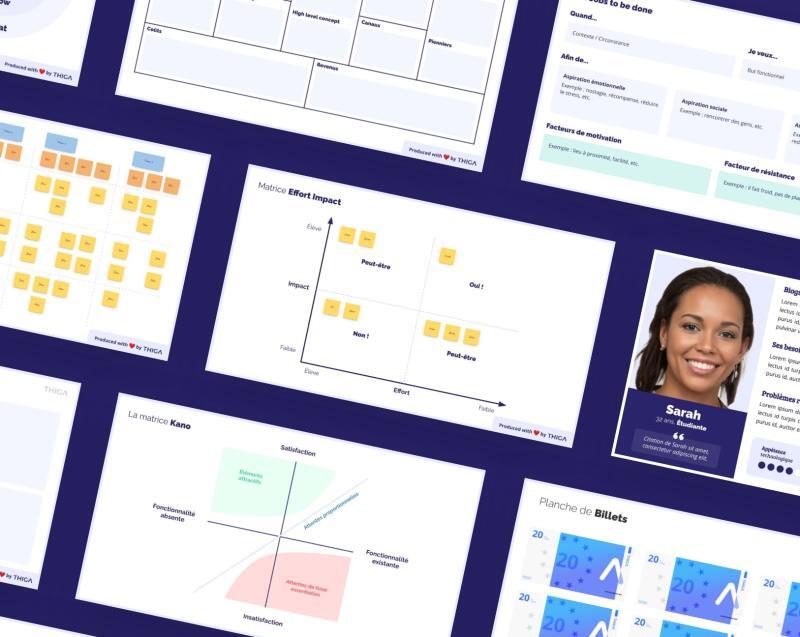
It's a realistic character representative of a segment resulting from user research.
This tool is essential when making decisions about a feature.
12
Jobs to be done
JTBDs enable us to explain why a user chooses one product over another. We don't start from the user's motivations or frustrations, but from his or her appetence for a product, from the point of view of the "job" it will do for him or her.
13
Card sorting
A technique frequently used in information architecture (but not only!), to understand how users mentally organize information. It's particularly useful for organizing (or reorganizing) the structure of a website or app.
14
Design critics
Design critics analyze a design and indicate whether it is achieving its objectives. Feedback is essential during the product design cycle. However, sharing unfinished work is naturally uncomfortable and often generates tension if the critique is not well structured.
15
User tests
User testing, what is it?
This consists of the evaluation of concepts, models or final products in real-life situations, with the aim of
1. Studying user behavior during interaction, and
2. Detecting interface usability problems.